Wednesday, 16 April 2014

Monday, 14 April 2014
Tupare Gardens Virtual Tours
This week most children are ready to seek review from others on their online tour of Tupare gardens before making final changes. Then their tours will be ready to share with the wider audience using a QR ( Quick Response) code to direct viewers to the tour.
We brainstormed some ideas on exactly what to give feedback on. This is what we came up with...


This week most children are ready to seek review from others on their online tour of Tupare gardens before making final changes. Then their tours will be ready to share with the wider audience using a QR ( Quick Response) code to direct viewers to the tour.
We brainstormed some ideas on exactly what to give feedback on. This is what we came up with...
- Information - is there enough?
- Is the information actually correct and accurate?
- Does it have at least 3 of the base criteria?
- Does it have the yawn factor? Or does it have the magic 5% factor?
- Does it have correct spelling, grammar and punctuation?
- Have we used the correct vocabulary for the purpose of the tour?
- How good was the tool we used to make the tour?
- What did we think of the layout and design?
- Is there too much reading?
- Colours - do the colours we have used make it easier to read/view?


Monday, 7 April 2014
Apostrophes - SPLT Group 1
We are learning to use apostrophes in the correct place.
|
Our prior knowledge:
- Used in shortened words = taking out a letter and putting in apostrophes
- Usually used before an ‘s’
Our Key Questions…
- What are the main rules for apostrophes?
- Where are apostrophes used?
- Why do we use apostrophes?
- When do we use apostrophes?
The Task:
Use our search skills to find and read about the rules regarding apostrophes.
Decide on the important rules and write into our own words. Add these rules to our personal SPLT document.
Create a (short!!!) Google presentation for the rest of the class that teaches them about the apostrophe rules.
A great website we have found is...BBC Skillwise Bitesize
A great website we have found is...BBC Skillwise Bitesize
Sunday, 30 March 2014
More P.E.E. writing - Abbie's
I am learning to P.E.E. in my writing - have a main point/topic sentence as the first sentence, then I elaborate.
Tupare gardens is a public garden in New Plymouth. Tupare has a river at the end of the gardens. There is a swimming hole in one part of it. The swimming hole is really deep. The river has a very fast current and there are some steps to get down to the river. The river is called the Waiwhakaiho. There are eels in the river that come out at night. The eels normally live at the end of the swimming hole by the bank. Tupare gardens are recommended by local people. If you like to look at gardens, this is the place to go.
If you are curious about Tupare gardens go to this website http://www.trc.govt.nz/tupare-home/
Written by Abbie
Thursday, 27 March 2014
I am learning to P.E.E. in my writing - have a main point/topic sentence as the first sentence, then I elaborate.
The Cascade Cliff
The Cascade Cliff

Here you will explore of the amazing history the Cascade Cliff at Tupare Gardens. The Cascade Cliff took 4 winters to build and some rocks from the Waiwhakaiho River made the stone in the Waterfall. The Cascade Cliff was named after a good friend of Russell Matthews his name was Cliff. The waterfall was made in winter because Russell Matthews had to build roads in the summer. The water flows when the tide of the river is high but when the tide of the river is low then it doesn’t flow as much water. The water from the river is the water from the Cascade Cliff so the Cascade Cliff’s water comes from the Waiwhakaiho river. The water flows underground to get to the Cascade Cliff.
By Eliala
Cascade Cliffs
Cascade Cliffs is a small waterfall in Tupare Gardens. It was built in the winter because Russell Mathews had work in the summer. Cascade Cliffs took 4 winters to build. It got its name from Russell Mathews good friend who thought that Cascade Cliffs was a good name for a waterfall.
The rocks from the waterfall came from the Waiwhakaiho River. There are rings of rocks with water in them what makes the Cascade Cliffs.
Here is a web sight to see the Cascade Cliffs:
By Emily
SPLT - Singular into Plurals
I am learning how to make words into plurals.
Plural = words that mean 2 or more of something
Singular words = there is only one!
Singular = goose
Plural = geese
S = mouse
P=mices? no it’s mice
S=fish
P=fish
Can you think of any others?...
Questions…
- What rules are there about using plurals to spell words?
- Do we need to know all the plural spelling rules or just a few?
- What are the most important rules?
Tuesday, 25 March 2014
PEE when I write (Point, Elaborate, Elaborate)
Today one of our writing groups was working on using P.E.E. in their writing. Here is what we discussed and our thinking around it.
I am learning to P.E.E. in my writing - have a main point/topic sentence as the first sentence, then I elaborate.
Audience: Teacher, People that have never been to Tupare
Task: Write a short magazine article about one special feature in Tupare
P.E.E.
P = Point (main point/topic sentence)
E = Elaboration (explain the main point a bit)
E = Elaboration (explain the main point a bit more)
Example:
At Frankley School we have a wonderful bush area at the back of our school. A couple of years ago we put possum traps up there. The bush has heaps of native birds and plants. In our bush we have a bush track.
Non Fiction Writing/Factual writing about a topic = true, real
|
Fiction Writing = made up
|
We don't usually use personal pronoun words like we, I, me, my
True facts
|
imaginative language
|
Writing Sentences
In writing today, one of our groups were discussing what a sentence is. We need to learn this because we are not at the level of writing proper sentences that make sense yet. Here are our ideas...
Sentences need to make sense.
"I am learning to use sentences".
What we know about sentences…
What we know about sentences…
Sentences start with a capital letter and end with a full stop.
Sentences have one idea in them.
Sentences have to have at least 3 words in them.
Sentences need to make sense.
SPLT Learning - Syllables
Today our SPLT group looked at improving our spelling through the use of syllables. Here is the what we recorded as our thinking and learning:
com/pre/hen/tion
I am learning to break words into syllables.
PK
- 2 words joined together? e.g. someone, into
- Is it a word and you break the word into small words?
We need to know…
- What does syllable mean.
- How do we use syllables
- What are syllables
- When do we use syllables
- Where do we use syllables
Keywords
- Syllables, learning
What is a syllable?
- A syllable is a part of a word/chunk in a word that makes a sound
elephant el/e/phant = 3
syllable syll/a/ble = 3
vegetable veg/e/ta/ble = 4
Anderson And/er/son
island is/land
en/cy/clo/pe/d/ia
pop/trop/i/ca
How does knowing about syllables help us to spell words?
- When you dont know how to spell a word, sound it out aloud, clap the syllables, write down the syllables you can hear
e.g pro/spec/tive
com/pre/hen/tion
Thursday's new learning:
Every syllable must have at least one vowel!
Eth/an
Dan/iel
Monday, 17 March 2014
To be sure, to be sure
St. Patrick’s day
St. Patrick’s day is a day to remember St Patrick and when he supposedly drove the snakes out of Ireland even though there were no snakes in Ireland, He was also very famous for bringing the christianity belief to Ireland. St Patricks day is usually celebrated on the 17 of march.
In Ireland they believe that there are Leprechauns that live in the forest and hide their gold, When you catch a leprechaun you have to always be looking at it because if you look away it will disappear with its pot of gold. leprechauns are dressed like shoe makers with a leather apron, pointed boots and a top hat, on thee day most people have corned beef and cabbage for dinner. St Patricks day is celebrated all over the world so everyone can be irish for a day.
By Oscar and Jordan

Sunday, 16 March 2014
Do You Like Hamburgers?
This week in class some of us discussed the difference between Surface Features and Deeper Features in writing.
Can you explain the difference?
A great way to think about it is to think of a hamburger...

The delicious bits are the ingredients inside. Without these, you just have bread. In our writing, this is the ideas - the parts/story that draws people in and wants them to read more. It is also our choice of language - the words we use in our writing help the reader to imagine what is happening in their minds. It is also the language techniques we use e.g. "Show, Not Tell". All these (and more) make our writing interesting and keep the reader (eater) coming back for more!
The bits of bread hold the burger all together. Without these our burger would just fall apart. Our writing needs to be held together as well. To do this we use proper punctuation, spelling and grammar. These allow the reader to make sense of what they are reading. They are not powerful like the bits inside the burger, but they stop the reader from just walking away from a big mess! Keep the reader reading by using proper punctuation, correct spelling and correct grammar. Without the buns, the burgers a mess. Without these, our writings a mess!
Can you explain the difference?
A great way to think about it is to think of a hamburger...
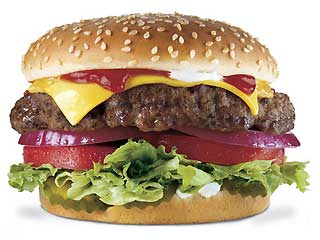
The delicious bits are the ingredients inside. Without these, you just have bread. In our writing, this is the ideas - the parts/story that draws people in and wants them to read more. It is also our choice of language - the words we use in our writing help the reader to imagine what is happening in their minds. It is also the language techniques we use e.g. "Show, Not Tell". All these (and more) make our writing interesting and keep the reader (eater) coming back for more!
The bits of bread hold the burger all together. Without these our burger would just fall apart. Our writing needs to be held together as well. To do this we use proper punctuation, spelling and grammar. These allow the reader to make sense of what they are reading. They are not powerful like the bits inside the burger, but they stop the reader from just walking away from a big mess! Keep the reader reading by using proper punctuation, correct spelling and correct grammar. Without the buns, the burgers a mess. Without these, our writings a mess!
Wednesday, 12 March 2014
Things that trip us up in reading...
Today a number of us were discussing what we find hard in reading, the things that "trip us up". We also had a quick discussion about what we can do about these things when this happens and when we find reading hard.
Here is a summary of what we discussed...
Over the next few weeks we will begin to learn about the powerful strategies that will help us become better and more accurate readers.
Over the next few weeks we will begin to learn about the powerful strategies that will help us become better and more accurate readers.
Thursday, 6 March 2014
Friday, 28 February 2014
Lending a Hand
Today a number of us helped out the Secret 67 HQ students. They were learning all about how to log in to Google Docs and send an email, all the skills we had learnt from the first week of school.
We had a blast - there was lots of questioning of the Juniors, lots of prompting them to think about how to solve some of the problems and lots of team work. It was neat to see the Seniors helping out the Juniors in this way. It also allowed our class to put to use the skills we had learnt. By the end of it many of the class were showing their buddies extra skills...here are some photos of us in action.


We had a blast - there was lots of questioning of the Juniors, lots of prompting them to think about how to solve some of the problems and lots of team work. It was neat to see the Seniors helping out the Juniors in this way. It also allowed our class to put to use the skills we had learnt. By the end of it many of the class were showing their buddies extra skills...here are some photos of us in action.


Thursday, 20 February 2014
Learning about vocab
Today we discovered that knowing what words mean is really important in learning. We are busy learning about virtual tours but not many of us actually knew what "virtual" meant. So we set about learning this. This is what we found out (we also learnt a few new words such as digital).


Subscribe to:
Posts (Atom)